
2020 was, for most of us, an extremely challenging year. Finding new ways of working and new ways of co-existing with family members. And for the health-conscious among us, finding new ways of keeping fit in both body and mind.
With most commercial gyms closed for the best part of the year, it’s been necessary to explore new ways of taking exercise, working out and chilling out.
Not to be defeated, we’ve laced up our running shoes once again and hit the streets. We’ve discovered online fitness classes, dusted off old bikes, virtual workouts, mental health-boosting apps and, in particular, our attention has turned towards creating home gyms.
Interest in home gyms has skyrocketed in 2020. We are converting spare bedrooms, garages, basements, attics and even sheds into home gyms at a remarkable rate. It’s partly out of necessity and partly the “Joe Wicks” effect (Wicks became a national treasure in 2020 on the back of his new stay-at-home gym routine for kids and families).
If you are eyeing that bit of spare space in your home and considering turning it into a fabulous workout space and relaxation zone for you and your family, read on for our greatest tips on how to maximise your space and ensure your gym lasts for many years to come.
Work out how much you could save
Did you know that there are 6,700 gyms and fitness clubs in the UK? And nearly 9 million people are members of commercial gyms and fitness clubs.
On average it will take only five years to pay back the money invested in a home gym
motive8
With average gym memberships coming in at around £70 per month (and some exclusive clubs charging many times more) it’s not surprising that there is a strong incentive for us to want to save money.
The average family has three members of a gym so membership could cost up to £2,500 per year. A typical home gym installation might cost in the region of £15,000. So, it will only take five years or so to pay back the money invested in the home gym.
Furthermore, gyms are opening and closing at an unpredictable rate, with local and national lockdowns causing havoc on the high street. And, as concerns around social distancing are high, it’s unsurprising that we are turning to the home as our main exercise space.
Fitness, your way
Our first tip is to carefully think about who will use your gym now and (more importantly) in the future. Maybe it’s just you and your partner today but, in the future, will there be children using the gym? Or perhaps an older relative? A home gym is an excellent opportunity to improve fitness for the whole family. Make sure you factor every potential gym user into your design.
Next, take a while to consider how you and your family want to keep fit. Not everybody wants to do cardio all the time and end up pouring with sweat. Most of those who dive into a new fitness regime and attempt too much, too soon, end up giving up. It’s far better to find a style of fitness that really suits you. Exercise should be a reward, not a punishment, and the feeling of wellbeing it generates should be the incentive.
Whilst treadmills, cross trainers, and cardio machines such as rowing machines are still extremely popular, there is a huge trend towards holistic exercises such as Pilates, meditation, and yoga.
Because every individual has different preferences, at motive8 we tend to think of home gyms as one of three or four different types.
The functional home gym is the most recognisable, with its steppers, kettlebells, resistance bands, hand weights, treadmills, and bikes.
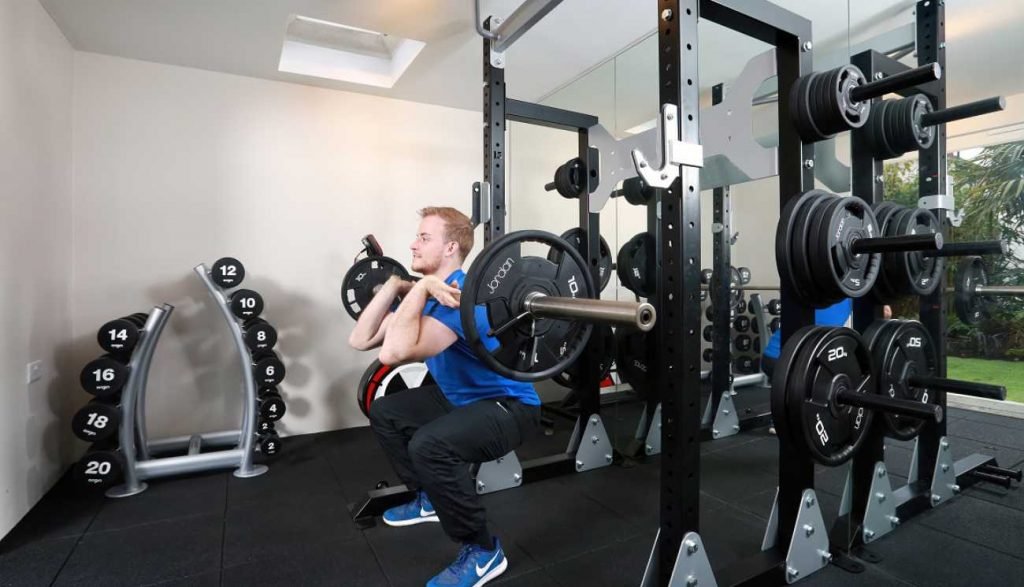
Whereas the Wellness oasis may not look like a commercial gym at all as it will tend to feature exercise mats, plants, mirrors, artwork, pleasant soft lighting, and a gentler ambience altogether.
Then again, the family gym is focused on the whole family from kids to grandparents, and zoned areas for each age group.
Find the right space
One of the biggest questions you may be asking is whether you have enough space to fit a home gym. Our customers have in the past converted garages, basements, lofts, spare rooms, annexes, garden buildings and side rooms.
If you are lucky enough to have a double garage (take a look at this amazing garage gym we created for one such customer) this is an ideal candidate for conversion to a home gym.
If you don’t have any existing space, you can always build a new structure. This of course will certainly require a team of home gym designers to achieve.
So, first of all, consider what space you have available. It’s amazing how much you can fit into a small space especially with an experienced designer overseeing the project, but there are limits. You will most likely need a space in the region of 5 by 5 metres for maximum effect. You need enough space between equipment to ensure adequate safety and make sure you don’t feel cramped.
Increasingly we are installing projectors and screens into new home gyms to take advantage of live streamed exercise classes, pre-recorded exercise classes and games console-based exercises. For best effect, these will require a whole blank wall.
Getting the vibe right
Gyms are spaces in which quite a lot of heat, moisture and vibration occur. And it’s a space where we breathe in very deeply and exhale a lot!

Failing to take account of these aspects will create a gym which is stuffy, dark, damp and maybe even smelly. For your home gym to really work it must be light, bright and properly ventilated. A room with large existing windows is ideal but, if necessary, it is well worth enlarging or creating new window spaces. Mirrors are vital in most gyms – and the bigger the better.
One of the most important factors in your home gym design will be ventilation and airflow. A gym without ventilation is likely to be abandoned quickly because it will soon become unpleasant, difficult to clean and generally unwelcoming. Ventilation may need to be installed separately. And without an adequate flow of air around the space, the quality of the air rapidly drops.
Other factors include temperature and humidity. These will be different from other rooms in your home and, for best effect, dehumidification, exhaust fans and heating may need to be installed professionally. It’s part of the overall cost but essential for getting a gym that will be used for a long time.
Consider new tech
The health and fitness space is extremely innovative and new inventions, gadgets, gizmos are coming out all the time. Whilst some might be passing fads, we think that some fitness trends are here to stay. So, pay attention to these trends and make sure your gym is designed with these innovations built-in:
Live streamed fitness classes
Why work out on your own when you can experience a class with a top-flight professional instructor? Choose your theme – from eighties-style aerobics to boxercise to yoga, barre, HIIT and … Mr Motivator. The worlds of fitness, entertainment and socialisation are colliding in the home gym.
Smart gym kit
The latest and greatest gym equipment comes with internet connectivity, allowing you to compete on leader-boards, set challenges, get livestreamed classes. The best of the bunch can be paired with your wearable tech such as heart rate monitors. So, your workouts can be assimilated into your overall movement throughout the day.
Build to last
Our last tip is perhaps the most important. It’s about building a gym that lasts for many years to come. Building a proper home gym should be an investment, not an expense. It’s an investment in your future and that of your family. So, attempting to save money at every opportunity could be a mistake.
This is especially important when it comes to equipment. Whatever equipment you choose it should be built to last. That does not necessarily mean brand new equipment – there is plenty of gym equipment on the second-hand market. But the last thing you want is to be
Your thought process should be: “What can I buy so that I never have to buy again?”
motive8
continually having to replace flimsy, fragile gym equipment. Your thought process should always be: “What can I buy so that I never have to buy again?”
motive8 can recommend the best equipment on the market that has stood the test of time. What equipment do we recommend? That all depends on your style of workout. A typical home gym will have some form of cardio, free weights and a stretching area. If you are interested in Pilates, then a reformer will probably be necessary.
Two or three yoga mats will be essential. Also remember essential items such as a skipping rope, dumbbells and resistance bands. But don’t skimp on these either.
Enjoy your fabulous home gym
Home gyms have come a long way since the days of a weights bench in a crowded garage. Modern families want a space that’s adaptable, good for all the family, flexible and will last for years. Using our tips before you get started will help you get a fitness facility in your home that will last a lifetime and bring joy and pleasure to you and your family.
At motive8 we are committed to helping customers build fantastic home gyms, no matter who will be using them or what their exercise preferences are. Please do get in touch with us to discuss your home gym project.